September 25, 2026
Reactive Skills: A Runtime for Agent Skills
Reactive Skills adds explicit workflow state, guarded transitions, and durable event history to human-readable agent skills.
Standard agent skills make practical knowledge portable. A SKILL.md can explain how to approach a task, which tools to use, and which conventions to follow.
That format works well for packaging guidance. It does not, by itself, define an execution contract for a workflow that spans many turns, tools, and interruptions.
For those workflows, the agent still has to figure out which phase comes next, whether the work is complete, what evidence counts as completion, and what should happen when a tool fails.
Reactive Skills Architecture (RSA) builds on the standard skill format. It keeps instructions human-readable, then adds explicit state, signals, guards, and durable event history around them.
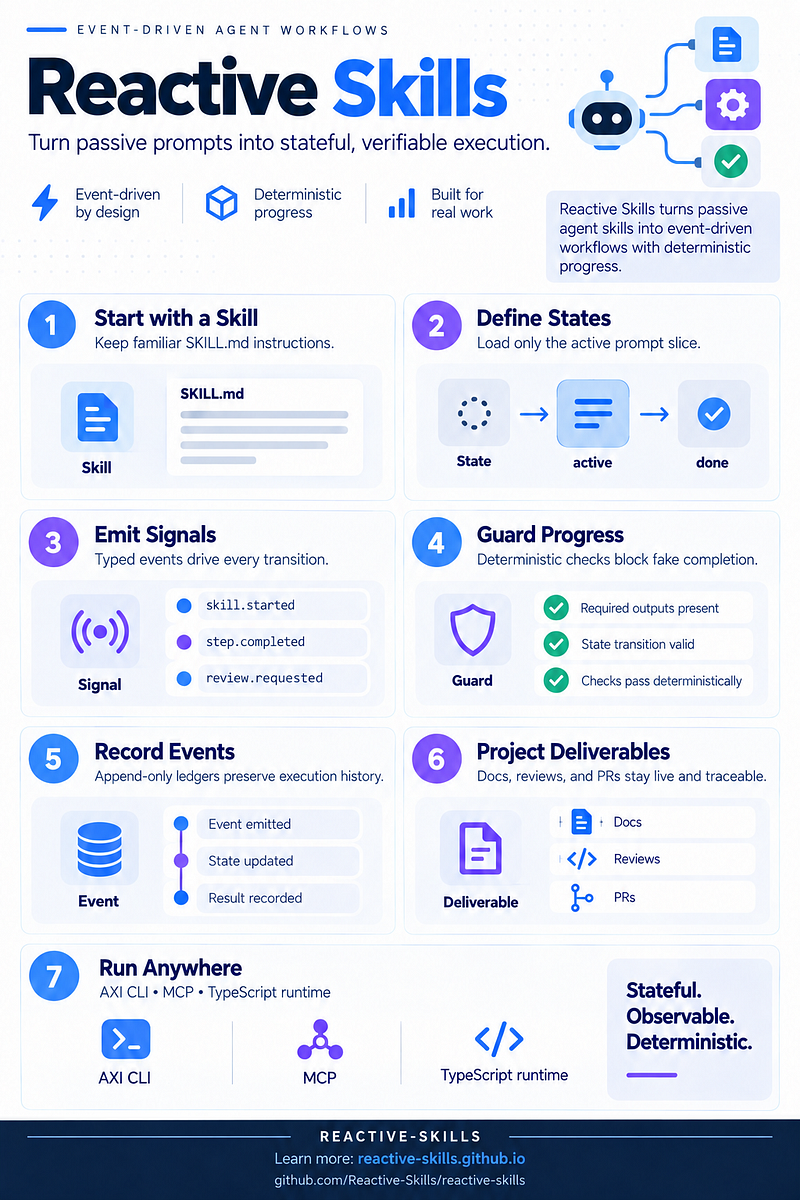
skills/<skill-name>/
├── skill.yaml            # States, transitions, and guards
├── STATECHART.md         # Mermaid statechart diagram
├── SKILL.md              # Skill entry point and runtime bootloader
├── states/               # Prompt templates for individual states
│   ├── state_1.md
│   ├── ...
│   └── state_n.md
└── skill-release.json    # Release and schema metadata
From instructions to execution state
A workflow might move through PLAN, IMPLEMENT, VERIFY, and DELIVER. At each step, the agent can load the active state's prompt and allowed tools instead of carrying every instruction for every phase into the turn.
Typed signals tell the runtime that something happened. Guards decide whether the matching transition is valid.
TESTS_PASSED:
  target: DELIVER
  guard: "event.payload.exit_code === 0"
The runtime evaluates the guard against the event before it advances the workflow. For this example, that means the event must contain a successful exit code. To make that evidence trustworthy, connect the signal to the test runner or another source you trust.
Hierarchical state machines also let related states share behavior. If a leaf state does not handle an event, the event can bubble to an ancestor state that does.
The simulator makes the active state, guard, signal, and event ledger visible together. This capture shows the linear FSM mode, with the hierarchical mode selector visible above it.
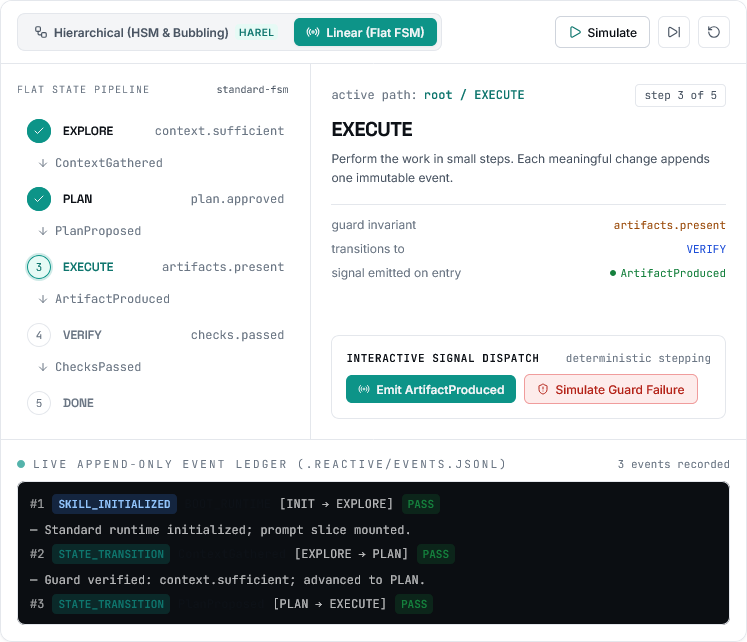
Loading only the active prompt slice can reduce the instructions sent on a turn. The project README currently estimates about a 70% token reduction for its setup, but the actual savings depend on the skill and the comparison baseline.
Standard skills still matter
RSA does not replace standard agent skills. Markdown remains a practical way to package procedures, domain knowledge, tool guidance, and team conventions.
The difference is the runtime contract. A standard skill describes what an agent should do. A reactive skill also records where the workflow is, which transitions are available, and what conditions must hold before it can move forward.
For a small, short-lived task, a standard skill may be all you need. For a multi-step engineering workflow, migration, review process, or release procedure, explicit state makes progress easier to inspect, verify, and resume.
When a check needs judgment
Many workflow checks are deterministic. A test process either exits successfully or it does not.
Other checks are semantic. For example, deciding whether a generated summary accurately reflects a code change is not just an exit-code check.
RSA can use optional typed judgment integrations, including Jev through TypeSafe AI, for bounded decisions like these. The judgment can inform a guard, while the runtime remains responsible for applying the workflow's rules and choosing the next state.
Evidence instead of conversation memory
RSA records signals and state changes in an append-only event history backed by JSONL and SQLite. Deliverables such as verification reports or review summaries can be rendered from that history.
That gives the workflow a durable record of what happened and why a transition was allowed. The next turn does not have to rely only on what the agent remembers from an earlier conversation.
Use the right layer
Use a standard skill when the task is small, short-lived, and mainly needs guidance. Use RSA when a workflow needs explicit phases, controlled transitions, verification, recovery, or resumability. Use a semantic judgment integration when a bounded decision cannot be expressed through ordinary programmatic checks.
Skills provide knowledge. State machines provide execution structure. Guards enforce transition rules. Event history provides evidence.
Reactive Skills gives agent skills a runtime while keeping the instructions readable and reusable.
Explore the Reactive Skills Architecture repository. The runtime and AXI packages are available on npm as @reactive-skills/runtime and @reactive-skills/axi.